His Mountain


Once I sat a-pondering upon a hill not mine own.
I borrowed someone else’s mound
To see what they might see.
Or think.
Or feel.

But I did not feel,
Nor think,
Nor see
Anyone’s sights, thoughts, or feelings
Other than my very own.

“Methinks”, I hushed to myself,
“That there is only One Who has seen all
Thought all
Felt all”,
Not only for himself; but for all mankind.

And this is His mound upon which I sit,
Aspiring only to embrace all the world
As He has, is, and ever will.

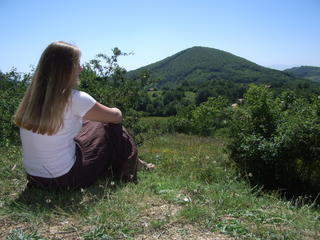
Picture from Rashan, Kosova, 2006

Midnight Office

I have a growing appreciation and affection for praying the Midnight Office. It’s neither Compline nor Lauds, neither the end of a day nor the beginning.

During the Evening Offices, the weight of the day’s occurances are nearby in the mind, bringing with them the concerns, problems, and blessings of the day past.

During the Morning Offices there is a certain anticipation for the upcoming day with its schedule, people, meetings, work, and all that we cannot forsee within them.

But at midnight the greatest distraction is your melatonin, and if you can suspend that for fifteen minutes, there is nothing to crowd the mind nor soul. No regret for the past day nor anxiety for the future one. It is peaceful and focused.

St. Mark of Ephesus said regarding the midnight office, “rising from sleep for it, we signify the transportation from the life of the deceit of darkness to the life which is, according to Christ, free and bright, with which we begin to worship God. For it is written, ‘The people who sat in darkness saw a great light (Is. 9:2; Mt 4:16).” From Patrologia Graeca 160, 1165D.

There is also a sense of redeeming the darkness, and filling it with the Light of Christ.

I would encourage you to try this, as I have been encouraged in trying to develop the midnight prayer into my daily cycle.

The Shades of Life


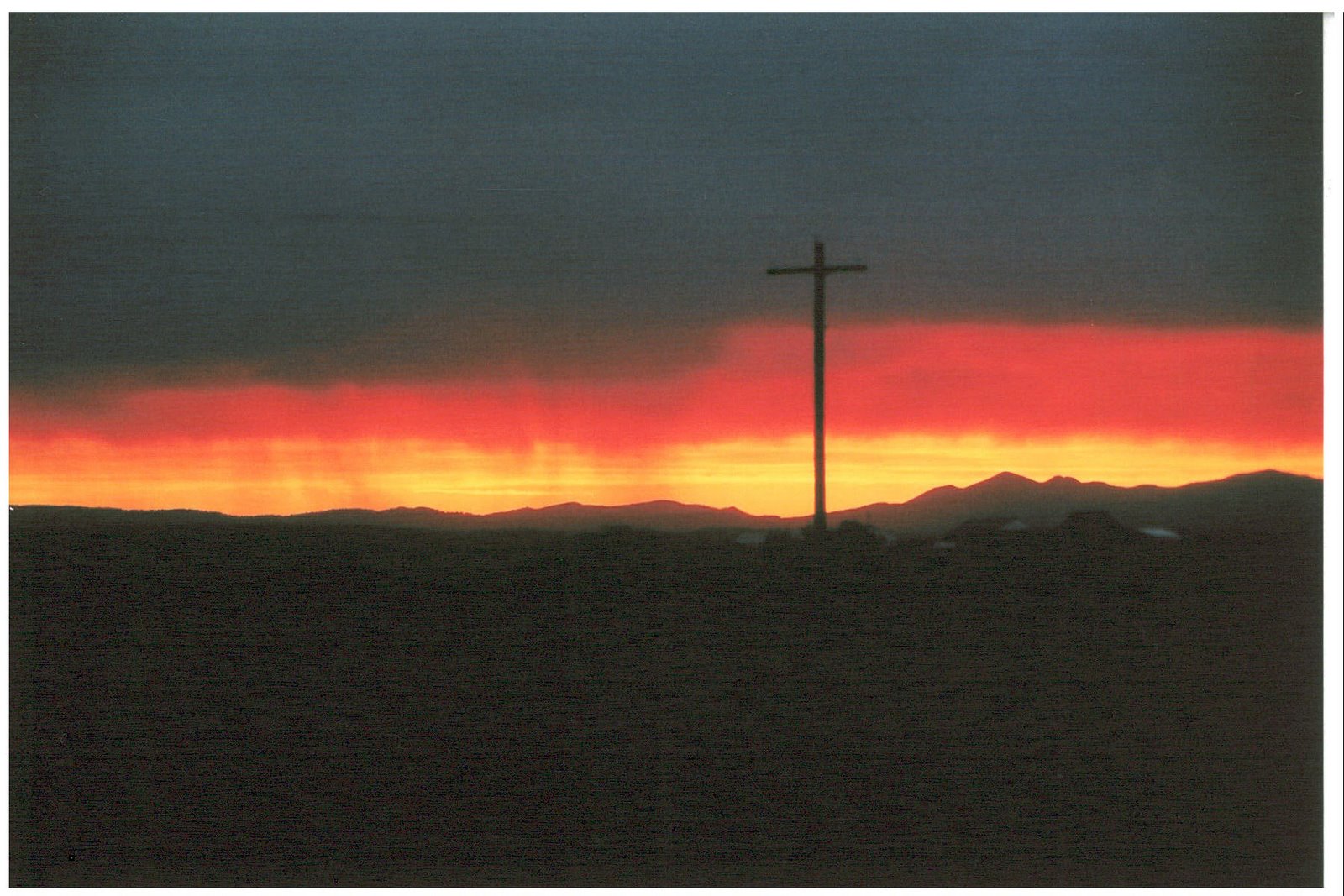
While there are moments of fiery brilliance as seen in the skies posted earlier, so often we must learn to handle the gray shades of life. Beautiful, comfortable, regular they loom above us.

Apparently this is the way the Church is too. For all of the beautiful purples and reds and glorious whites of liturgical colors – green – yes, green – is the color we have for twenty-four weeks straight. Green. The color that the trees are on all regular days. Green. The color of the grass ten months out of the year.

My life has seemed gray of late. Or green. During a season when the green is supposed to be preparing for those few months of brilliant leaves and fall colors, my sky has been gray. It’s a good gray, with subtle shades, but it is not full of passionate oranges and reds. I think I am being a glimpse into so many people’s lives: get up, feed the kids, go to work, get home, make dinner, go to bed; next day: get up, feed the kids, go to work, get home, make dinner, go to bed. Maybe a couple days out of the month have a chisel-tipped pink highliter scratch over them – but most are the same.

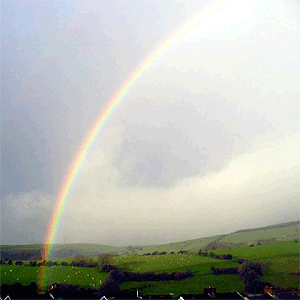
I don’t want that life. So, how do I make my gray more brilliant? Is it simply by seeing the myriad of colors that go into gray? Or that rainbows are most clearly seen peeking through the gray skies? I think I am going to try to be alright with gray. Try to makethe grays beautiful in a grayish way. I’ll tell you if I start seeing rainbows.

Caritas


“To love at all is to be vulnerable.
Love anything, and your heart will certainly be wrung and possibly be broken.
If you want to make sure of keeping it intact, you must give your heart to no one, not even to an animal.
Wrap it carefully round with hobbies and little luxuries; avoid all entanglements; lock it up safe in the casket or coffin of your selfishness. but in that casket – safe, dark, motionless, airless – it will change.
It will not be broken; it will become unbreakable, impenetrable, irredeemable.
The alternative to tragedy, or at least to the risk of tragedy is damnation.
The only place outside Heaven where you can be perfectly safe from all the dangers and perturbations of love is Hell.” C.S. Lewis’ The Four Loves

Some questions on love:
– Why are your closest friends and family amazingly adept at “pushing your buttons”? What is it about philial affections that can make us prone to quick offense and subsequently quick repair?
– What is it about our soul that finds the greatest satisfaction and fulfillment in the most sacrificial of loves? I say soul because it doesn’t seem as though it would satisfy the flesh, but perhaps I am missing something here.
– What is the connection between love and duty? You have to love your husband, even when he seems unloveable; you have to love your brother even when he’s unloveable, etc… Being human, we have to acknowledge love goes so much deeper than the eros, so is the deepest love (agape) still tied to duty, or is it the loves in between?
– Very important question: why is “love” always associated with the heart?

I have begun working on some essays on loves, so am probing for your thoughts.

The Sky Above

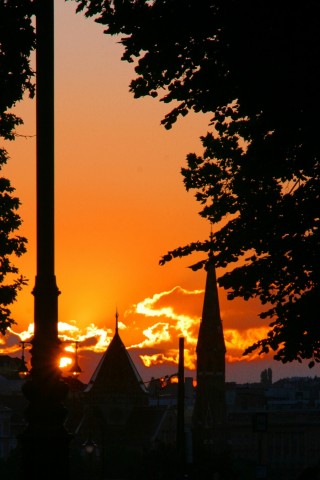
Once my mom asked me if I would ever stop taking pictures of the sky. I told her that I would stop when I saw the same one twice. God uses a palette that we cannot even imaging; I suppose He creates a new color each day, one we may not even perceive. Just because it pleases Him. And the colors and clouds never cease to casually change at His command. I like to think that our awe at such a sight is echoed in the sky, as each ray realizes it is part of something gloriously wonderful and continues to obey the whim of the Artist above.


Budapest sunset on my birthday by Leslie Mezger

Eggplant


Have you ever contemplated the beauty of eggplant? The colors are amazingly swirled together, so sometimes it looks black, sometimes ruby red, and somehow purple all over. I think I might keep an eggplant on my counter all the time now, just to learn more about the hand that made it. Maybe I’ll even work up the courage to try to capture its beauty on canvas. But today I’ll just stare at it.

From the lips of children

My 2nd-5th grade students had a discussion regarding the Fall of man today. They brought up some things I have never thought about before, and am very humored by:
If Adam hadn’t sinned:
1) Would we still get papercuts?
2)Would we die if we got shot by a gun (the gun was of course created, not to hurt people, but to shoot fruit off of high trees)
3) We would be so crammed with people there wouldn’t be any room to move.
4) We would have serious traffic jams!
5) If you tripped, would it hurt?
6) Would you be able to swim underwater (because if you couldn’t die you couldn’t drown….)
7) If you were eaten by a shark, would you live inside it forever.
8) If you stepped on a beetle, would it die?

Henry Tudor

My first lecture of the school year was on “Memorizing”, how to effectively store and recall information, the way the brain remembers, etc… While preparing, I was trying to find a history poem to demonstrate that even the dates, people, events of history can be put into rhyme and aid the memory. This is what I found (though I didn’t use it with the students due to its PG rating):

I WANT A BOY

Henry Tudor said to Catherine
When he heard she was expecting
‘Darling, you must now prepare
To give birth to my son and heir
Girls are stupid, soft and silly
My baby has to have a willy.’

‘Sorry mate,’ said Henry’s wife
‘I may just be your trouble and strife
But it really isn’t up to me
Whether the baby’s a he or a she
My little egg is unisex
It’s YOUR SPERM that determines the sex.’

‘Rubbish,’ said Henry. ‘That’s not true.
The baby’s sex is down to you.
Don’t try and put the blame on me
If you have a girl, I’ll divorce you and leave
I’ll marry Anne Boleyn instead
And if Anne has a girl, I’ll chop off her head.’

And that’s exactly how Henry behaved
The wives who had daughters he never forgave
But now that the Tudors are long, long gone
We know Catherine was right and Henry was wrong